Pathways to Resilience and Mental Health

को अ॒द्धा वे॑द॒ क इ॒ह प्र वो॑च॒त्कुत॒ आजा॑ता॒ कुत॑ इ॒यं विसृ॑ष्टिः ।

ICMR Task Force Project

Every story has that one villain who refuses to die. You defeat it once, the credits almost roll… and then, it returns, once again. Even Stronger. More Familiar. As if it had been waiting patiently in the shadows all along.

Trauma works in much the same way. You can spend months rebuilding your life, only for an ordinary day, a certain smell, a song, or a date on the calendar to awaken a version of yourself you thought you had already left behind.

What Trauma Actually Is and the Universal Search for Relief

As physician and trauma expert Dr. Gabor Maté says, trauma is not about what happened, but the wound that lingers inside. In The Realm of Hungry Ghosts, he explores how addiction, chronic illness, and emotional dysfunction often originate in unresolved trauma and disconnection from self. It is an event, or a prolonged series of events, that completely overwhelms the brain and the body’s ability to cope, leaving lasting marks on our emotional and physiological systems. Because everyone’s nervous system is uniquely wired, two people can experience the exact same event and process it completely differently
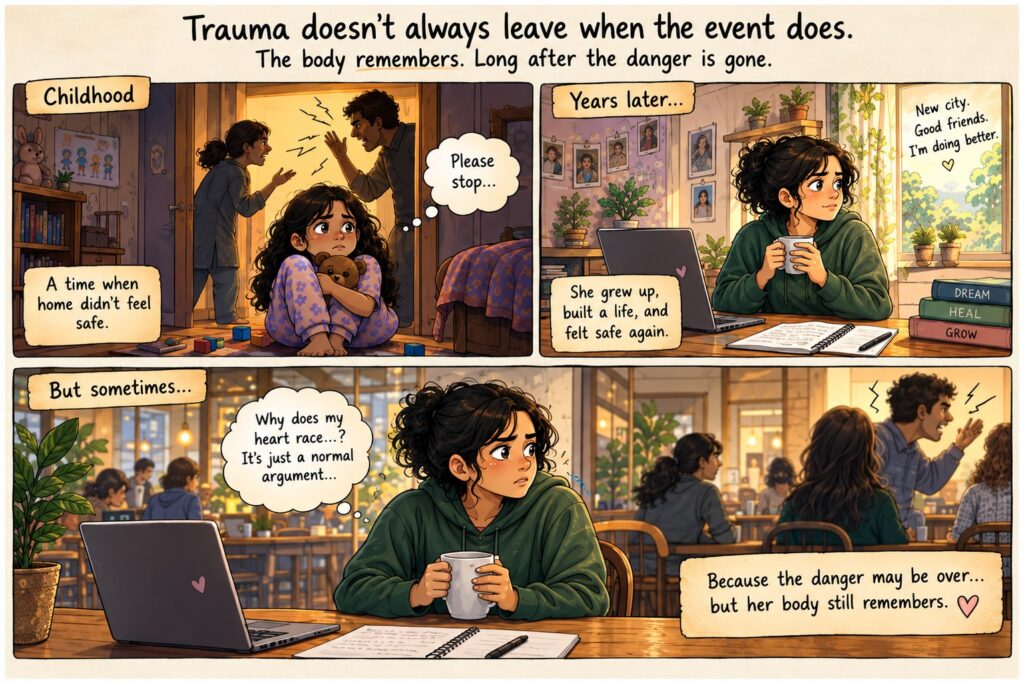
When the Body Remembers

While no two trauma histories look identical, almost everyone who has walked this path shares one universal desire: Relief. This could be relief from the mind (quiet from flashbacks, nightmares, and intrusive thoughts), relief from the body (freedom from sudden physical pain, nausea, or trembling when reminded of the past), relief from the weight (an end to feeling constantly anxious, exhausted, and on guard). To find that relief, we first need to understand how trauma throws off the brain’s internal housekeeping.

The Traumatized Brain: An Overprotective Symphony

Our brain functions like an interconnected orchestra. When trauma occurs, the entire symphony changes its tune, disrupting the brain’s natural housekeeping and information processing systems. 

Under normal circumstances, our brain seamlessly files memories away like old documents in a cabinet. But under intense threat, your brain prioritizes immediate survival over organized filing. It stops treating memories equally, throwing its standard information processing rules out the window.
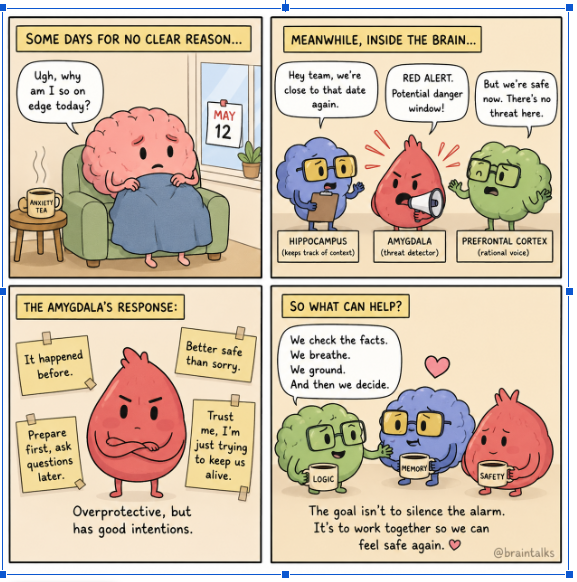
image 2

The comic illustration perfectly captures the main players in this internal dynamic:

  1. The Hippocampus (The Time Stamper)

This acts as your brain’s internal librarian. Its main job is to keep track of context, organizing details like the where, the when, and the chronology. It is supposed to slap a clear “Past” label on memories.

  1. The Amygdala (The Threat Detector)

Think of the amygdala as your brain’s internal smoke detector or alarm system. Its job is to constantly scan the environment for danger. Crucially, the amygdala is biologically biased, naturally attaching far more meaning to negative events than positive ones. From an evolutionary standpoint, remembering danger is vital for survival. It flags these negative events with high emotional intensity, so you never forget how to protect yourself.

  1. The Prefrontal Cortex (The Rational Voice)

Located right behind your forehead, this is your logical, thinking brain. It represents the rational voice, evaluating situations to tell the amygdala when there is actually no threat here.
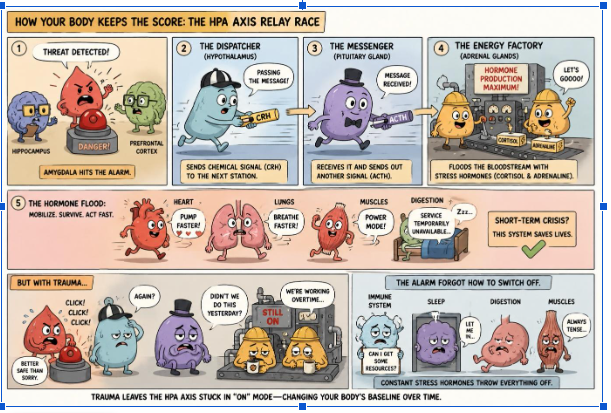
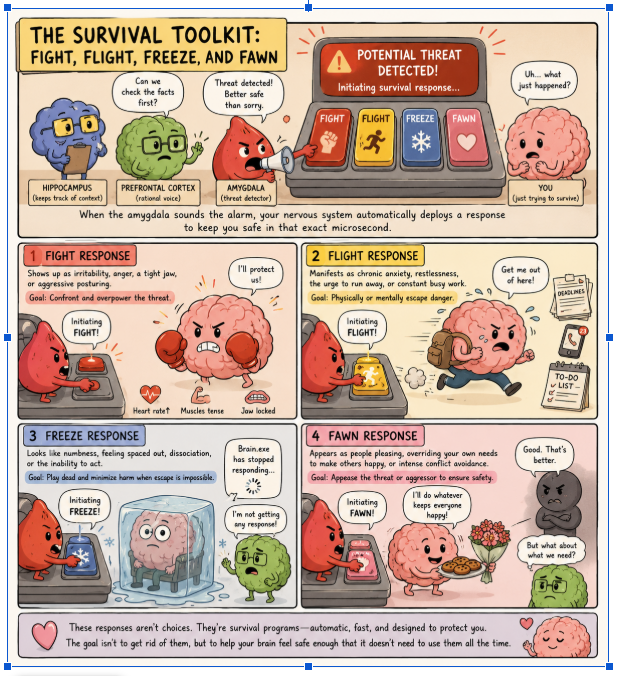
image 3

Why Certain Cues Trigger Us?

This biological setup perfectly explains the trauma anniversary effect.

Because the hippocampus did not time-stamp the original trauma properly, the memory is stored alongside sensory fragments of the environment: the specific angle of the winter sun, the smell of autumn leaves, the heavy feeling of a Sunday evening, or a certain transition in temperature.

Days later, when the calendar rolls around and those exact environmental cues reappear, your hypervigilant amygdala recognizes the pattern. It is an incredible display of your brain trying to anticipate danger using past data. As the hippocampus notes, your brain recognizes that you are close to that date again. It does not realize that days have passed. It simply sees the cues, assumes danger is imminent, and fires up the alert!

image 4

Epigenetics: The Blueprint’s Footprint

Does trauma have an even deeper biological signature? Researchers are looking into epigenetics, the study of how our environment and experiences change how our genes behave.

To understand this, imagine your DNA is a massive instruction manual for your body. The words in the book never change. However, life experiences can add chemical sticky notes or highlights to certain pages, changing how a page is read. This process is called methylation.

When a person experiences severe or prolonged trauma, chemical modifications like methylation can change how stress-regulating genes, like one called FKBP5, are expressed. Studies in trauma-exposed populations, including Holocaust survivors and their descendants, show that these chemical sticky notes can alter stress response systems long after the event has occurred, and can sometimes even be passed down through generations.

While scientists are still actively debating the full scope of this, it proves one vital truth: trauma is a deeply physical, biological reality, not just a psychological concept. 

Rewiring the Symphony

If trauma can reshape memory, hormone regulation, and even gene expression, then recovery is about helping these interconnected systems recalibrate. Resilience is not about becoming unaffected by stress; it is about how effectively the brain and body regain balance after a challenge. Like an orchestra that has fallen out of sync, healing is not about silencing one instrument but helping every section find its rhythm again.

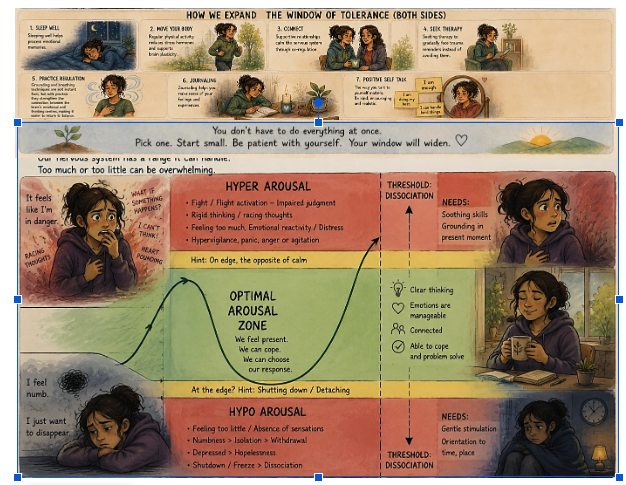
One way to understand this is through the window of tolerance: the range in which we can think clearly, regulate emotions, and respond without becoming overwhelmed or shutting down. Trauma often narrows this window, so situations that are objectively safe may still feel threatening. Recovery is therefore less about avoiding stress and more about gradually widening this window.

images 5

 Some chapters leave marks that cannot simply be erased, and some echoes may always linger. But resilience is not measured by never hearing the alarm again. It is measured by the growing ability to pause, regain your footing, and keep moving despite it.

Trauma may shape our story, but it does not have to write the ending. The brain that once learned to survive is also capable of learning to heal. And perhaps that is the most extraordinary part of being human: We carry our past with us, yet we are never condemned to relive it forever. 

Note: All the illustrations are made by the author, using AI prompting.

About the Author

Garima Modi is an undergraduate student at the Indian Institute of Science Education and Research, Mohali, interested in the biology behind human behaviour. She explores questions at the intersection of psychiatry, neuroscience, and psychology to understand the mechanisms that shape how we think, feel, and respond to the world around us.